 Avalaunchapp
 connects Avalanche fundraising with XAVA staking and token-sale participation
Avalaunchapp connects project fundraising with token sales for eligible XAVA stakers and Avalanche validators. Known as Avalaunch, the launchpad helps projects raise funds through initial decentralized exchange offerings (IDOs). Its vesting marketplace lets holders trade supported locked allocations while the original release schedules remain in force.
Bottom line: Vesting-marketplace trades transfer future token claims while the original unlock schedule governs when those tokens become claimable.
Fundraising produces a capped token allocation
A token allocation sets the maximum amount an eligible participant can purchase in a project’s sale. Avalaunch organizes fundraising around these purchase entitlements and the subsequent distribution of project tokens. In its November 12, 2025 ecosystem update, the platform reported at least 30 project launches and $23 million raised across those launches.
Sale access and allocation trading serve different tasks
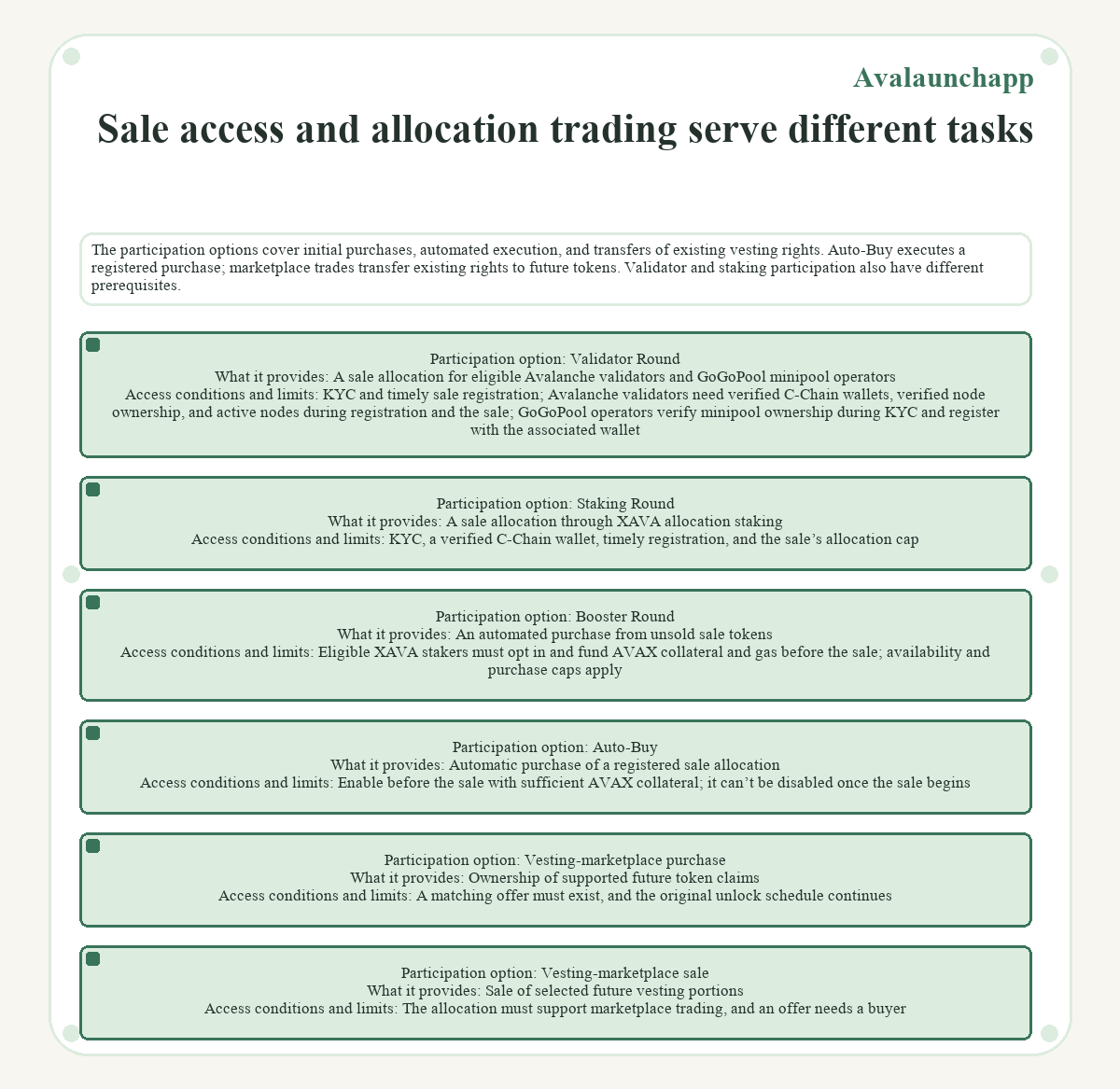
The participation options cover initial purchases, automated execution, and transfers of existing vesting rights. Auto-Buy executes a registered purchase; marketplace trades transfer existing rights to future tokens. Validator and staking participation also have different prerequisites.
| Participation option | What it provides | Access conditions and limits |
|---|---|---|
| Validator Round | A sale allocation for eligible Avalanche validators and GoGoPool minipool operators | KYC and timely sale registration; Avalanche validators need verified C-Chain wallets, verified node ownership, and active nodes during registration and the sale; GoGoPool operators verify minipool ownership during KYC and register with the associated wallet |
| Staking Round | A sale allocation through XAVA allocation staking | KYC, a verified C-Chain wallet, timely registration, and the sale’s allocation cap |
| Booster Round | An automated purchase from unsold sale tokens | Eligible XAVA stakers must opt in and fund AVAX collateral and gas before the sale; availability and purchase caps apply |
| Auto-Buy | Automatic purchase of a registered sale allocation | Enable before the sale with sufficient AVAX collateral; it can’t be disabled once the sale begins |
| Vesting-marketplace purchase | Ownership of supported future token claims | A matching offer must exist, and the original unlock schedule continues |
| Vesting-marketplace sale | Sale of selected future vesting portions | The allocation must support marketplace trading, and an offer needs a buyer |
Registration connects XAVA staking to a specific sale
Holding a stake establishes allocation power; completing registration connects an eligible participant to an individual offering. Avalaunch’s staking model avoids fixed entry tiers and sets maximum allocations per participant for each sale. A larger stake therefore doesn’t provide an unlimited right to buy project tokens.
Sale participation requires know-your-customer (KYC) verification, a verified Avalanche C-Chain wallet, and eligibility under jurisdiction restrictions. Avalanche network validators must verify node ownership and keep the node active during registration and the sale. Avalaunch added GoGoPool minipool operators on January 16, 2024; they verify minipool ownership during KYC and register with the associated wallet. They don’t need to hold or stake XAVA. These conditions distinguish operating an Avalanche validator from staking XAVA in the launchpad’s allocation pool.
Registration has its own closing time. Completing KYC or depositing XAVA doesn’t reserve participation after that window closes. Registering for the Staking Round locks the participant’s total stake until that sale completes. The project’s sale schedule determines when the relevant purchasing round opens, and the participant’s allocation limits how much can be bought.
Auto-Buy addresses attendance during the purchase window. It uses deposited AVAX to execute the registered allocation purchase when enabled and sufficiently funded. XAVA staking and the AVAX purchase budget have separate jobs, so an allocation isn’t evidence that the purchase has already occurred.
The Booster Round draws on tokens left unsold after the earlier rounds. Its documented automation processes opted-in participants in stake order, subject to funding and purchase limits.
Vesting trades transfer future claims
For supported allocations, marketplace trading changes who holds a future token claim while preserving its unlock schedule.
A holder can retain some vesting portions and offer others for sale. The marketplace buyer route supports acquiring those future claims without original IDO participation or KYC. The purchased tokens remain subject to their scheduled releases.
The dashboard distinguishes claimable tokens from the total position, which also includes tokens still vesting. Its implied allocation value includes both categories. A total position therefore isn’t the same as the amount available to claim immediately.
A sale of vesting rights can release capital before the token unlock, provided a buyer accepts the offer.
Refund eligibility follows the individual sale
Refund availability depends on the offering’s policy and the participant’s actions concerning that sale. Avalaunch’s April 10, 2023 policy excluded users who had claimed tokens or interacted with the vesting marketplace for the relevant offering. It also tied refunds to specified price-protection conditions. That framework described sale-specific protection, so a refund window from one offering can’t be applied automatically to another.
The distinction affects the choice between retaining an unclaimed allocation and trading its vesting portions. Where the offering makes those actions disqualifying, a token claim or marketplace interaction can remove the refund option. The applicable policy determines the deadline and any price trigger; a marketplace listing alone doesn’t establish a right to reimbursement.
Did Avalaunch become Nullshot?
Avalaunch remained a separate launchpad when its former Twitter account transitioned to the Nullshot account. In the November 12, 2025 ecosystem update, Avalaunch described the launchpad as operational alongside the newer product.
Avalaunch and Nullshot are distinct products within the XAVA ecosystem. XAVA Labs is the research and development initiative behind that portfolio. Its documented work also includes the TypeScript Agent Framework and a pipeline of additional products. The shared token connects those initiatives, while their functions remain distinct.
Nullshot’s documented purpose is AI-assisted community co-creation, with contribution tracking for ownership distribution. Avalaunch’s purpose is fundraising and token distribution for external projects on Avalanche. Choose between entering a project’s token sale, buying an existing vesting claim, and contributing to product creation through Nullshot.
Common questions about Avalaunchapp
Can I earn XAVA rewards without buying tokens in an IDO?
XAVA allocation staking can earn platform rewards without an IDO purchase. The staking model separates earning XAVA from choosing to buy a project’s tokens. Sale participation adds eligibility and registration requirements. Reward amounts follow the applicable redistribution and reward arrangements, so staking doesn’t establish a fixed return.
Are staking deposit fees charged on the sale allocation?
A staking deposit fee applies to XAVA entering the staking contract, while an allocation fee relates to the token-sale allocation. These charges use different bases even when both are collected in XAVA. The staking documentation also treats compounded rewards as a new deposit. Fee amounts are adjustable, so an old percentage isn’t a permanent quote.
Can I switch sale rounds after confirming registration?
The documented registration process fixes the selected Validator Round or Staking Round after confirmation. A wallet can choose only from rounds for which it’s eligible. Qualifying for both doesn’t grant purchases in both initial rounds. The Booster Round operates separately as an opt-in mechanism for unsold tokens.
Is the maximum allocation set before registration closes?
The documented model sets maximum allocations after registration closes. Tokens available for the sale, registered interest, and the distribution of qualified stakes inform that limit. The maximum purchase entitlement therefore isn’t a single XAVA threshold that carries unchanged from one offering to another.
Does the vesting marketplace support sales from before February 2023?
The February 17, 2023 marketplace guide excludes sales that preceded the Deepwaters IDO. Marketplace support began with that offering, so holders of earlier allocations can’t use this feature to buy or sell those vesting positions.